Narrow Leaf Milkweed
$4.50
Native
A Lifeline for the Monarch on the Western Migration
In stock
Product Details
A lifeline for the Monarch on the western migration.
Narrow Leaf Milkweed is one of the most ecologically vital plants you can grow in a western food forest or native garden. Slender, elegant, and quietly powerful, it weaves itself through the dry margins of meadows and roadsides with an understated confidence that belies its extraordinary importance. This is not merely a beautiful plant—it is a biological lifeline, a thread in the vast, ancient tapestry of the Monarch butterfly migration that has unfolded across the western landscape for millennia.
Native to the western United States and deeply rooted in the valleys, foothills, and semi-arid slopes of California, Oregon, Washington, Nevada, and Idaho, Narrow Leaf Milkweed is the primary host plant for Monarch butterflies (Danaus plexippus) along the Pacific Flyway. As Monarchs make their extraordinary annual migration from their overwintering grounds on the California coast inland toward their summer breeding territories, they depend almost entirely on native milkweed species to lay their eggs, nourish their larvae, and fuel the next generation. Without milkweed, there are no Monarchs. It is that simple, and that urgent.
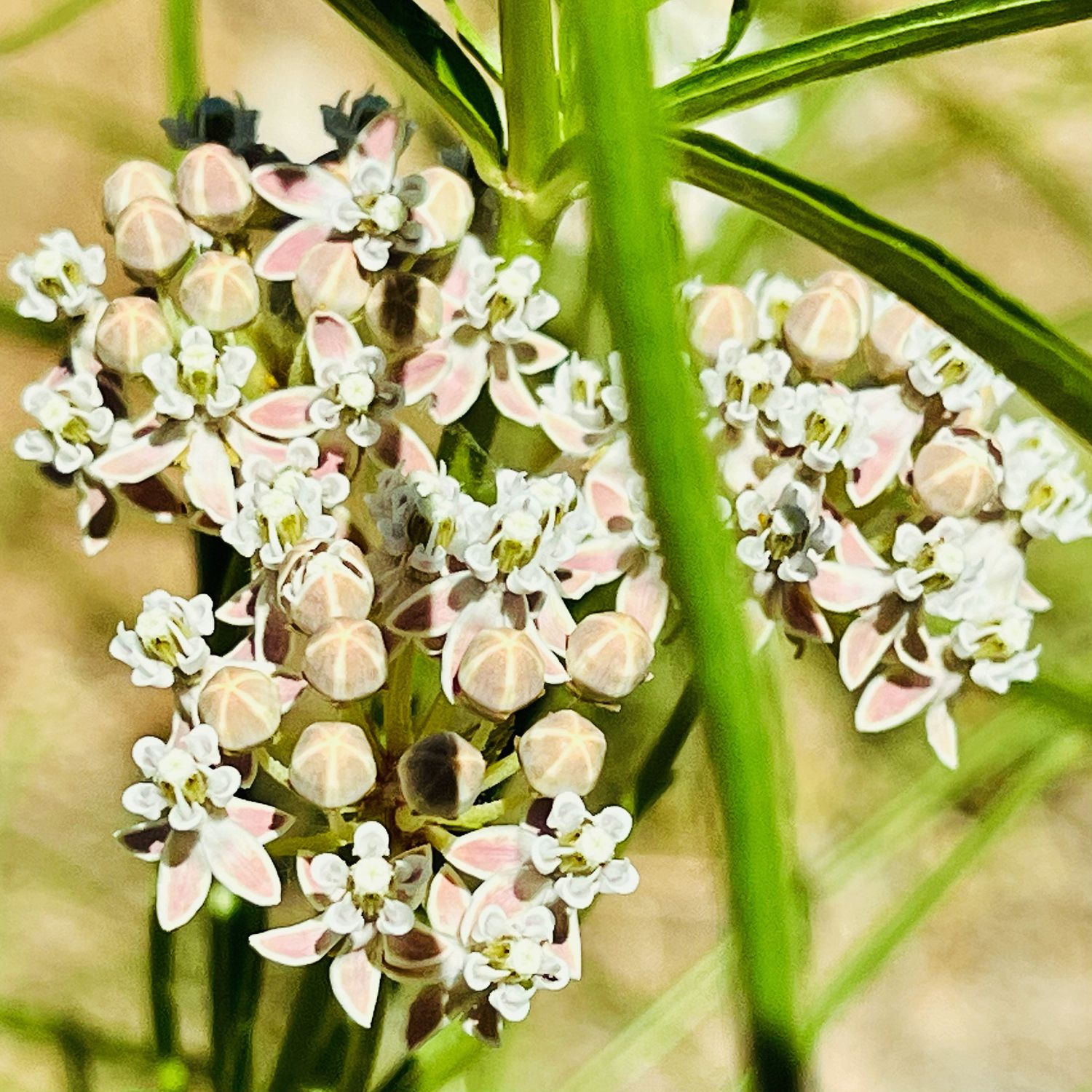
Narrow Leaf Milkweed is particularly critical along the western migration corridor because it blooms in mid to late summer—precisely when Monarch populations are actively breeding and moving through the inland valleys and high-desert edges of California and the Great Basin. Its clusters of small, intricate pink and white flowers provide abundant nectar for adult butterflies, while its long, narrow leaves serve as the sole food source for Monarch caterpillars. By planting Narrow Leaf Milkweed in your food forest or garden, you are not just adding a native perennial—you are restoring a critical waystation on one of nature's most remarkable journeys.
Beyond its role in the Monarch lifecycle, Narrow Leaf Milkweed is a generous contributor to the broader ecological community. Native bees, wasps, beetles, and a host of beneficial insects are drawn to its nectar-rich blooms. Its deep, fibrous root system stabilizes soil, suppresses weeds, and builds organic matter over time. Once established in a self-regulating food forest system, it spreads naturally through both seed and rhizome, quietly expanding its footprint and deepening its ecological contribution year after year.
USDA Hardiness Zones: 6–10. A hardy, drought-tolerant native perennial that thrives across a wide range of western climates, from the coastal valleys of California to the dry interior of the Great Basin. Particularly well-suited to semi-arid and high-desert conditions.
Perennial Potential: A true long-lived perennial that spreads naturally through both seed dispersal and rhizomatous root growth. Once established, a single planting will expand steadily over time, building a self-sustaining colony that returns reliably each season without replanting.
Sun Exposure: Full sun. Narrow Leaf Milkweed thrives in open, sunny positions and performs best with at least 6–8 hours of direct sunlight per day. It tolerates light partial shade but may produce fewer blooms and less vigorous growth in shadier conditions.
Soil Requirements: Lean, well-draining, and sandy to loamy soils with a neutral to slightly acidic pH of 6.0–7.5. Like most native milkweeds, it is adapted to poor, dry soils and does not require rich amendment. Avoid heavy clay or consistently moist soils. Thrives in the rocky, nutrient-poor soils of the high desert where other plants struggle to establish.
Planting Time: Direct sow in fall for natural cold stratification over winter, mimicking the plant's natural seed dispersal cycle. Alternatively, cold-stratify seeds in a damp paper towel in the refrigerator for 30 days before direct sowing in early spring. Soil temperatures of 65–85°F produce the best germination rates.
Planting Depth & Spacing: Sow seeds 1/4 inch deep, pressing lightly into the soil surface. Space plants 18–24 inches apart to allow for natural rhizomatous spread. Given room to expand, Narrow Leaf Milkweed will gradually colonize a wider area, creating a more impactful waystation for Monarch butterflies and other pollinators.
Watering: Highly drought tolerant once established. Water regularly during the first growing season to encourage deep root and rhizome development. Thereafter, deep, infrequent watering is sufficient. In the high desert, established plants survive on natural rainfall alone once their root systems are fully developed. Overwatering is the most common cause of failure—this plant thrives on neglect.
Temperature Sensitivity: Exceptionally tolerant of heat and drought, making it ideally suited to the temperature extremes of the Eastern Sierra and the Great Basin. Dies back to the ground in winter and re-emerges reliably in spring. Young seedlings may benefit from light mulching in areas with harsh, exposed winters.
Offering: 30 seeds